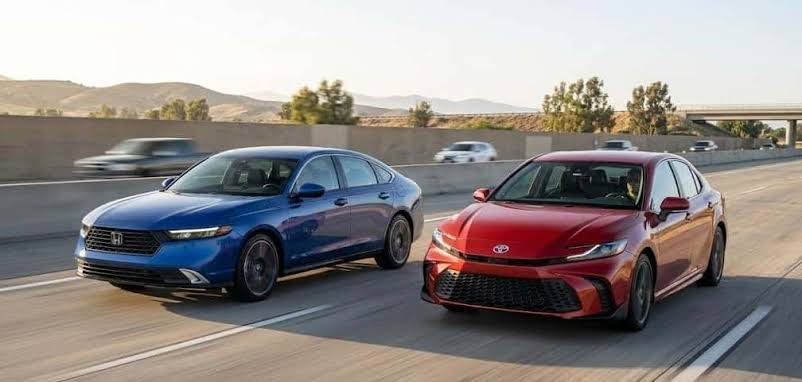
I spent three weekends in a row driving Camrys, Accords, Sonatas, and a Legacy back to back — same stretch of Highway 30, same gas stations, same annoying construction zone near the interchange. That’s the only way to actually tell these cars apart anymore, because on paper, they’re all suspiciously similar. Four doors, 40 mpg give or take, a touch screen, and a warranty. It is not the differences listed on the window sticker that make the difference; it is those felt in your hands and your back after two hours.
1.The Hybrid Question Isn’t Really a Question Anymore
A few years ago, picking a hybrid meant giving something up — usually acceleration, sometimes cargo room. That trade-off has basically disappeared. What was surprising about the change from the boxer engine of the Legacy to the hybrid system of the Camry was that the Toyota Camry just takes off at a traffic light. There is no delay, no turbo lag; it just takes off using the electric motor.
Where this really pays off is the kind of driving nobody puts in a brochure: sitting in traffic on the way to pick up your kid from practice, crawling through a school zone, idling at a drive-through. That’s where hybrids save you real money, because the gas engine barely runs. On the highway the difference is smaller — physics doesn’t care what powers your car once you’re at 70 mph — but the transitions between electric and gas power are smooth enough now that you’d never notice unless you were watching the dash display.
One thing I didn’t expect: my mechanic mentioned that regenerative braking is quietly saving hybrid owners a decent chunk of change on brake jobs. He said he’s seeing hybrid brake pads last past 70,000 miles on cars that would’ve needed pads at 40,000 in the old days.
See also: GHRP-2, Explained Like We’re Talking Over Coffee
2.What the Cabin Actually Feels Like After Two Hours
Forget the spec sheet. Get in the car, adjust the seat, and drive somewhere with bad pavement. I did exactly that on a rough patch of old county road outside town — potholes, frost heaves, the works — and it’s honestly the fastest way to tell these cars apart. Some soak it up. Others let every seam in the asphalt into your spine.
Road noise is the other giveaway, and it’s not something you catch on a five-minute test loop around the dealership lot. You need highway speed, ideally with a semi passing you, to hear how much tire roar and wind noise actually makes it into the cabin. The Accord impressed me here — quieter than I expected for the price point.
Seats matter more than people think, especially if you’re doing anything over an hour behind the wheel. I’m partial to power lumbar with real side bolster shape, not the flat bench-with-a-button some manufacturers still pass off as “premium.” I also can’t stand hunting through a touchscreen menu to turn the fan up while I’m driving — give me a physical knob. Rear seat space is worth checking with actual adult humans, not just a tape measure; sitting behind my own driver’s seat position (I’m 5’11”) is the real test, not the 38-inch number on the spec sheet, though that number is a decent shorthand if you can’t do the real thing.
3.Side-by-Side: What Each One Actually Brings to the Table
| Vehicle | Powertrain | Combined MPG | What Stands Out |
| Toyota | 2.5L 4-Cyl Hybrid | 47–51 | Holds its value better than almost anything else in this class, and the hybrid is now the default, not the upsell |
| Honda Accord | 2.0L 4-Cyl Hybrid / 1.5L Turbo | 44–48 | Best rear legroom in the group, and it actually handles like someone tuned it on purpose |
| Hyundai Sonata | 2.5L 4-Cyl / 2.0L Hybrid | 32–47 | The 10-year warranty is hard to argue with, and the tech doesn’t feel like an afterthought |
| Subaru Legacy | 2.5L Boxer, AWD | 30–33 | The only one here with standard all-wheel drive — worth it if you deal with snow every winter |
4.The Money Question Nobody Wants to Think About at the Dealership
Here’s the thing about that shiny out-the-door price: it’s not what the car actually costs you. Depreciation is the expense nobody feels at the moment, and it’s usually the biggest one you’ll pay over five years — bigger than gas, bigger than insurance, bigger than oil changes combined.
I’ve watched friends load up a top trim with every option box checked, only to find out three years later that a base model with the safety package attached sold for a much smaller percentage haircut. It’s counterintuitive, but the market doesn’t reward extra leather and a bigger sunroof the way you’d think.
Warranty length matters here too, and it’s worth actually reading the fine print instead of trusting the salesperson’s summary.
5.Safety Tech: The Stuff You Actually Notice vs. The Stuff That Annoys You
But that’s not where the story ends, because while crash ratings make headlines, they can’t tell you what it’s like to have to put up with a car’s driver assist features every day. I’ve been in vehicles where the lane centering battles you on a turn, and vehicles where you hardly even know it’s there.
Adaptive cruise control on crowded highways is the one I use regularly, not the one I demonstrated once at the dealership. And blind spot warning must be able to inform me of the presence of something without causing me to jump out of my skin every time.
6.The Costs Nobody Mentions Until You Own the Car
Your loan payment is the smallest part of the math. Insurance quotes on these cars can swing a surprising amount depending on how the sensors and cameras are mounted — repair a cracked windshield with a camera behind it, and you’re not just paying for glass anymore, you’re paying to recalibrate a whole system. Bigger wheel packages on a Toyota Camry mean pricier tires down the line, too.
7.Questions People Actually Ask Me
Is a midsize sedan really still the right call, or should I just get a small SUV?
Honestly, it depends on what you’re hauling. If it’s mostly people and not much gear, a midsize sedan rides lower, handles better, and gets noticeably better mileage than a comparable SUV. If you’re hauling a dog, strollers, and camping gear every weekend, the sedan’s trunk will start to feel small fast. I’d test drive both before assuming the SUV is the “safe” choice — a lot of people default to it without actually needing the extra height.
Are hybrids actually worth the extra money up front, or is that just marketing?
In my experience, yes — most drivers make that premium back in two to three years, sometimes faster if you’re doing a lot of city driving. The math gets even better when you factor in the brake savings and the resale bump. Where it gets murkier is if you drive mostly highway miles at a steady speed; the gap between hybrid and gas mileage shrinks there, so run your own numbers before assuming it’s a slam dunk.
How much rear legroom do I actually need?
The spec sheet number is a starting point, not gospel. Somewhere around 37 to 40 inches is the range where adults stop complaining on a road trip, but body shape and how the seat is bolstered matter just as much as the raw number. Bring whoever’s actually going to sit back there to the test drive — don’t take my word or the brochure’s word for it.